
CNI Labs User Highlight: Kateryna Kusyak, Physics PhD Candidate
Welcome to the CNI Shared Labs User Highlight series, where we showcase the people behind the innovative research taking place in our facilities. Through conversations with graduate students, postdoctoral researchers, faculty, startup founders, and industry users, we'll provide a behind-the-scenes look at the diverse science and engineering enabled at CNI. In this feature, we sit down with Kateryna Kusyak, a fifth-year Phd. student at the Max Planck Institute for the Structure and Dynamics and research scholar in Columbia University's Physics Department.
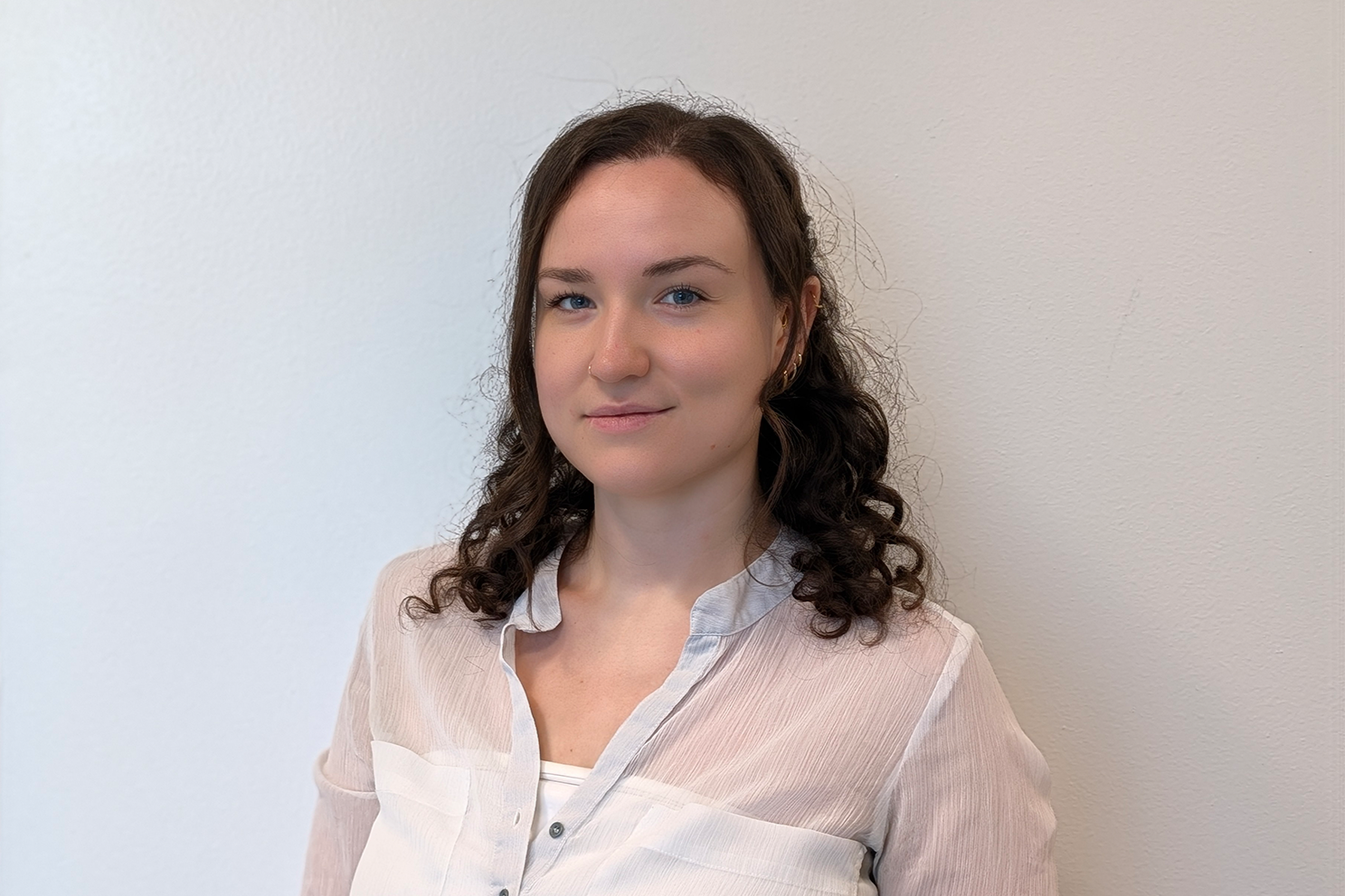
Kateryna Kusyak, Physics Ph.D. candidate at Columbia University.
Tell us a little bit about yourself.
I was born in Lviv, a city in the west of Ukraine, but we immigrated to Germany right before I turned 5. I grew up in a small city right outside of Hamburg.
Lviv is lovely and has a strong coffeehouse culture, as well as Austrian and early twentieth-century architecture, since it was once part of Austria-Hungary. It has large parks and cemeteries both within and just outside the city, and many cafés and bars.
Hamburg is a northern City in Germany, the second largest one. It is very green and has many rivers and canals and is referred to the city with the most bridges in the world. It has a very vivid night life with bars and clubs. It is also very rainy and gray and has actually less sunny hours than parts of Antartica, which is night for half a year. So, if you plan on visiting, come during summer!
Where did you complete your undergraduate degree?
I finished my degree in the University of Hamburg in Nanoscience, which was a great mixture of my favorite subjects in high school – Chemistry, Physics and Math. It took me a while to find my actual research focus because I found joy in many aspects, so I did spectroscopy on organic compounds and then some synthesis and characterization of catalytic nanoparticles for fuel cells, for which I spend some time in Padua, Italy until deciding for my masters project to do something more electrical engineering related and developing transmission line designs to investigate nano and micro sized structures in the THz frequencies. I won the Klaus von Klitzing Prize for the best thesis for my research, which was like a cherry on the top, as I had so much fun working on this project and pushing the status quo.
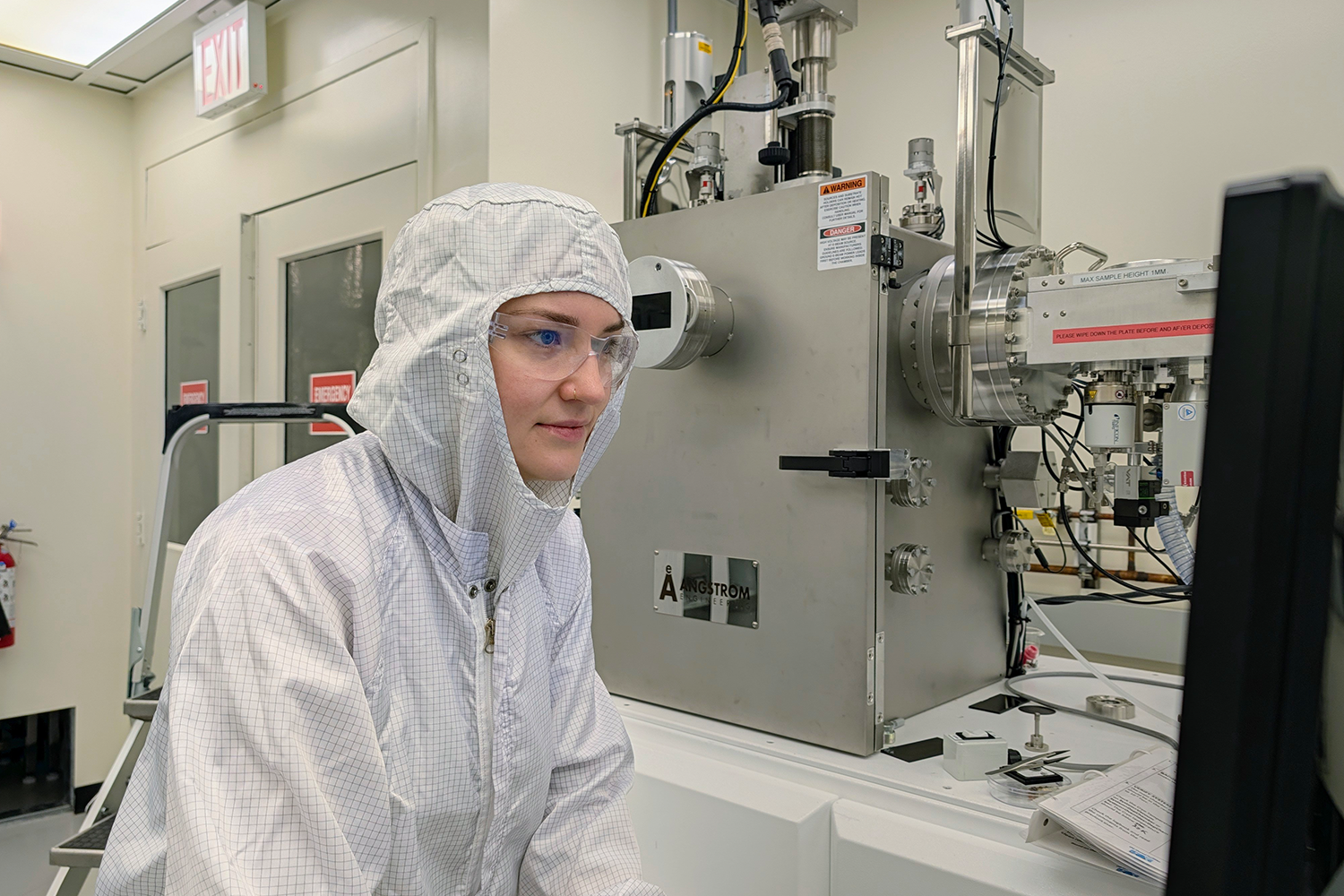
Kateryna using the Angstrom high vacuum electron beam evaporator to deposit thin films that make up portions of her device.
Tell us about the program you are in here at Columbia University.
I’m a Physics PhD student in my fifth year. I’m at Columbia as a part of the Max Planck–New York Center on Non-Equilibrium Quantum Phenomena, which is a collaborative center between Max Planck, Columbia University, the Flatiron Institute, and Cornell University. I’m also part of the Max Planck Graduate Center for Quantum Materials.
Which research group are you a member of, and what is the group's overall focus?
I’m in the group of James McIver, who is a relatively new faculty in the physics department. The research focus is transport phenomena in quantum materials at terahertz frequencies and on ultrafast timescales.
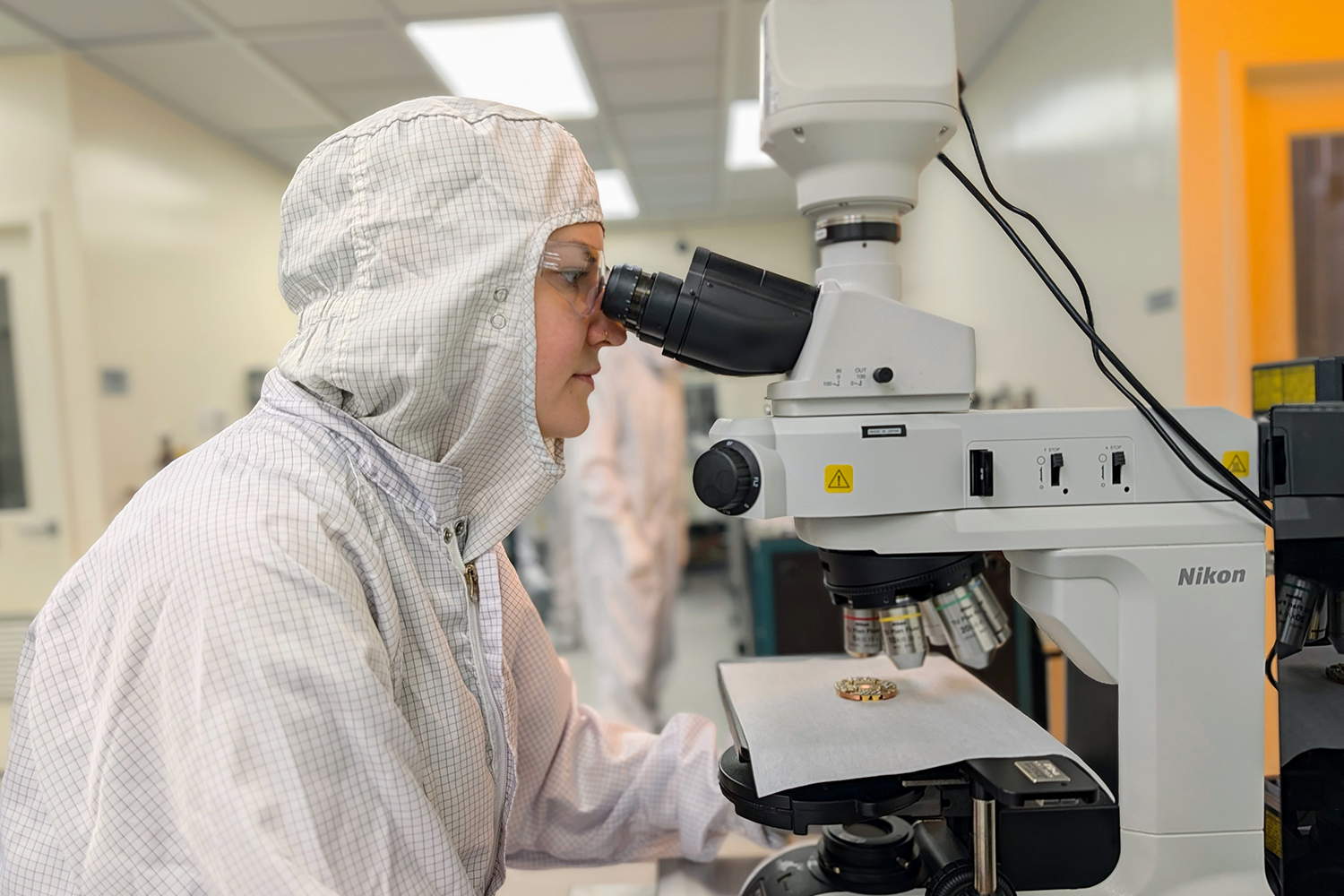
Kateryna inspecting her fabricated device using one of CNI’s optical microscopes in the Nanofabrication Cleanroom.
How would you describe your research to someone outside your field?
I look at how different wavelengths of light change the intrinsic properties of few atom layer thin quantum materials, so called van der Waals materials. I investigate their change on different timescales ranging from a few pico seconds (one trillionth of a second) to multiple seconds and see how pushing its state out of equilibrium leads to changes in its electrical properties. Moreover, I’m targeting hidden and topologically protected states to see whether they can be stabilized at will.
Can you tell us about some potential future applications of your work?
Topological electronic materials are special because they exhibit lower dissipation relative to normal metals, and highly directional electrical conduction. We hope that controlling these systems basic properties could lead to applications in low-energy-usage transistors, as optically controllable links between quantum processors, or other exciting applications.
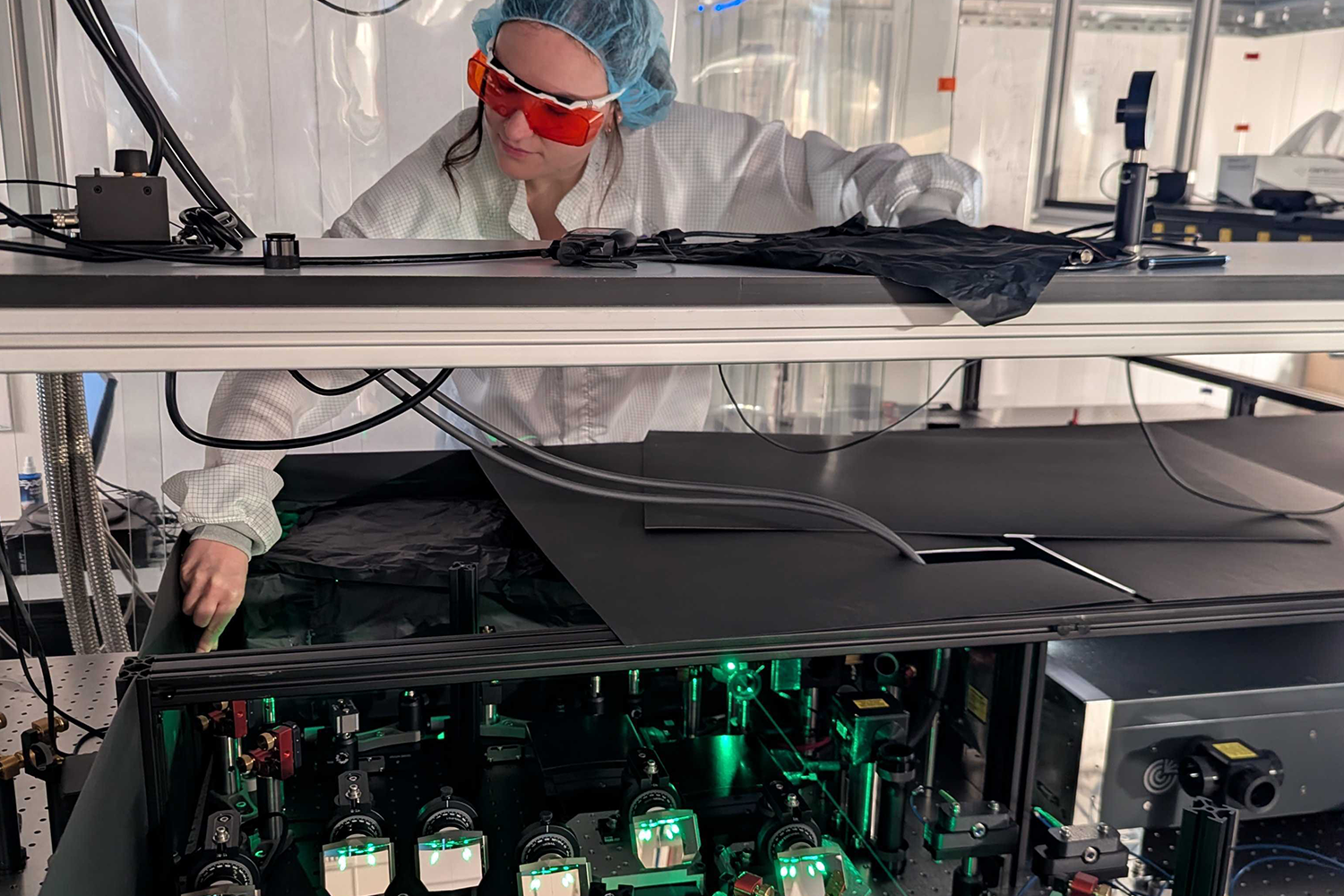
Kateryna adjusts an optical component of a multi-path laser array. These types of setups area a key tool used in the McIver Lab to probe and manipulate matter with light.
How did you decide to specialize in this area?
When I first learned about graphene, a single sheet of graphite, which is just one atom thick I was fascinated and wanted to learn more about materials which are truly two dimensional. Confining a state to lower dimensions changes its physics, thus can be seen as a control knob. Van-der-Waals materials are very convenient in this regard, since slicing them from a three-dimensional crystal to a two-dimensional sheet only requires separating each individual layer from one another, and those layers are only weakly bound via Van-der-Waals forces (hence the name). I wanted to learn more about the properties of this material class and how they could be manipulated. From my time as a spectroscopist I knew I loved working with lasers on ultrafast timescales, so it all came together really nicely.
Where do you hope your career will take you in the next five to ten years?
I am open to many different directions. A fundamental driver for me so far has been my curiosity about how the world works and my love for learning. I hope my future lets me do this more, be it in quantum computing or rocket ships. I have a genuine curiosity for different cultures and I hope I’ll get to work in Japan or Korea one day.
As many researchers, I hope for my work to have a positive impact. Be that in future device technology or also just knowing that I taught someone something fascinating.

Putting the physics of motion into practice! Kateryna captures the joy of dancing salsa at an outdoor social.
What do you enjoy doing for fun outside of your graduate program?
I love to dance, especially latin dances like salsa. During summers you can find me by the piers or parks on salsa socials, figuring out whether my lead tries to dance on1 or on2 (salseras iykyk).
I’m into hiking and have backpacked through Portugal, Spain and Italy. I like to spend time reading. A weird special interested of mine is communication, both verbal and nonverbal and psychology and brain functions. I think if I hadn’t fallen in love with STEM, I would have done research on how communication and language shapes our brain and behaviour.
If you could go back to the first day of your graduate studies and tell yourself one thing, what would it be?
Everything can be learned and every project can be tackled when you break it down to smaller digestible parts. Take your time to do so. Everyone started somewhere and their confidence comes from the hours put in and nobody really cares if you don’t know something yet, just try your best and you’ll be fine.
LinkedIn: https://www.linkedin.com/in/kateryna-kusyak-03a19019b/
The McIver Laboratory: https://mciverlab.com/